I am sad to be posting this announcement that the North Texas Art Conservation Symposium has been postponed until later this year. We will be hosting this event as soon as the all clear for social normality is announced, so keep an eye on your inbox. Until then read a good book and write a few letters.
Brad
Showing posts with label NTAAC. Show all posts
Monday, March 16, 2020
Saturday, March 7, 2020
North Texas Art Conservation Symposium April 7th
Join us for our annual afternoon talk with five art conservators from Dallas/Fort Worth museums, library archives, and private practice as they discuss the challenges of preserving our cultural heritage. This symposium sponsored by the City of Dallas Office of Cultural Affairs and the North Texas Association for Art Conservation aims to broaden community awareness of recent art conservation projects in Texas. Attendees with an interest in art, history and science will enjoy this opportunity to look beyond the surface and witness the challenges faced by art conservators as they evaluate and implement treatments to forestall the march of time.
This year’s five panelists are:
Tish Brewer, “A Foray into Artificial Anatomy: Conserving a Papier-Mache Model of a Horse's Hoof”
Jesse Hunt, “The Conservation of Distinctiones Dictionum Theologicum, Strassburg 1474.”
Diane Knauf, “The Gentling Collection: Treatment of Multi-Layered Works on Transparent Paper”
Elena Torok and Lance Lander, “Recent Projects and Conservation of Time-Based Media”
This event is free and open to the public. Tickets available through Eventbrite
Tuesday, April 7, 1:00 PM– 5:00 PM
Latino Cultural Center
2600 Live Oak St.
Dallas TX 75204
For more information please contact the North Texas Association for Art Conservation at NTAAC@yahoo.com
Wednesday, October 9, 2019
Art Conservation October Happy Hour
Join us for the next NTAAC Happy Hour. Let's catch up and also talk about the recent NTAAC Conservation Symposium held last August. Looking for some feedback .... how can it be better, more inclusive, more impactful? Who knows, maybe you already have a topic you would like to present at the next symposium?!
Tuesday Oct 15th at 6:00
See you there,
Brad
Friday, August 9, 2019
Art Conservation Conversations Event Aug 20th
Curious about who takes care of art and cultural property? Go behind-the-scenes with 8 local art conservators. An afternoon all about history, conservation treatments and restoration of fine art. Come hear conservators in private practice discuss the care taking of cultural objects from murals, to NASA chairs! It's all about conserving some of the best art and saving it for later.
Tuesday, August 20, 1:00 PM– 5:00 PM
Latino Cultural Center
Tuesday, August 20, 1:00 PM– 5:00 PM
Latino Cultural Center
2600 Live Oak St.
Dallas TX
Sponsored by The City of Dallas & the North Texas Association for Art Conservation
Facebook event page: https://www.facebook.com/events/381691749156415/
This event is free and open to the public so come join us and invite your colleagues.
See you there,
Brad
Monday, April 22, 2019
A Thursday Lunch To Talk About Broken Stuff
It's been too long since we all got together over some golden fried filets of fish and talked about broken stuff!!! Let's fix that by meeting up this Thursday at Big Shucks.
I know everyone has been working hard on some interesting projects, exhibits, presentations... and we would all love to hear about them. This would also be a great time to talk about the future of conservation, preservation and restoration in DFW. So get out of your studio, lab, office and join the conversation.
This Thursday April 25th at 12:30
Big Shucks
6232 E Mockingbird Ln
Dallas, TX 75214
See you there,
Brad
Friday, October 5, 2018
NTAAC Meetup Looks at the Artwork of Tracy Hicks
This NTAAC get together will be at the Sp/n Gallery at UTD and will focus on the artwork of Tracy Hicks. Tracy approached art with a documentation/scientific flair, creating works in many different mediums including works on paper, video, photography, bronze, plastic resin, and taxidermy just to name a few.
This retrospective exhibit is a great opportunity us to observe and discuss the long term conservation issues surrounding a wide range of modern art mediums.
We'll meet at the gallery on Thursday, Oct 18th at 4:00pm.
UTD campus
3020 Stewart Dr
Richardson, TX 75080
As always this NTAAC event is open to people, businesses, museums, organizations, societies and students who work with conservation, preservation, display or handling of art or historic artifacts. Please feel free to share this event notice.
Pull yourself away from that work desk and let's talk about broken stuff!
See you in the gallery,
Brad
Brad
Monday, April 16, 2018
Texas Association of Museums Conference in Houston
The Texas Association of Museums conference is just about to begin: April 18th - 21st. As always there will be lots of panel discussions and events to attend.
NTAAC is inviting you to join the conversation at the Art Conservation Roundtable on Thursday morning.
This session will consist of five Texas based art conservators stationed at five tables. The conservators will introduce themselves and give a brief description of the field their table will be discussing. Participants move freely from table to table and ask questions.
Conservation fields represented will include: Furniture/ Frames- Alton Bowman, Scrapbooks- Olivia Primanis, Books- Kimberly Kwan, Photograph- Fernanda Valverde, and Ceramics - Brad Ford Smith. Popular topics will include but not limited to proper handling, storage, basic care, signs to watch out for and where to find more information. Each conservator will have demonstration materials and other information to help illustrate the various issues pertaining to their field.
NTAAC is inviting you to join the conversation at the Art Conservation Roundtable on Thursday morning.
This session will consist of five Texas based art conservators stationed at five tables. The conservators will introduce themselves and give a brief description of the field their table will be discussing. Participants move freely from table to table and ask questions.
Conservation fields represented will include: Furniture/ Frames- Alton Bowman, Scrapbooks- Olivia Primanis, Books- Kimberly Kwan, Photograph- Fernanda Valverde, and Ceramics - Brad Ford Smith. Popular topics will include but not limited to proper handling, storage, basic care, signs to watch out for and where to find more information. Each conservator will have demonstration materials and other information to help illustrate the various issues pertaining to their field.
Thursday, April 12, 2018
Salt Cured Proof Of Occupancy
Ron Siebler and Mark Birnbaum keep making great videos about historic preservation. This time the project involves a 155 year old curing shed on the Opel Lawrence Farmstead in Mesquite Texas, a clump of salty newspaper and Tish Brewer, a paper conservator.A clump of newspaper, bricked by salt and sand, is unearthed from the dirt floor of a 155 year-old curing shed and provides a clue to its history.
Click the video link below to see the video on Vimeo
Video
Do you have a conservation or preservation project you would like to share? NTAAC would love to see it! Contact Brad at info@studiosixartconservation.com
Monday, March 5, 2018
Recap Gels In Conservation Conference 6 of 6
The London Gels in Conservation Conference: An IntroductionWritten by Jodie Utter, Senior Conservator of Works on Paper, Amon Carter Museum of American Art.
Michelle Sullivan, “Rigid polysaccharide gels for paper conservation: a residue study”
This blog post is part of a series of observations about the London “Gels in Conservation” conference co-hosted by the Tate and IAP (International Academic Projects, Ltd). In mid-October, over the course of three days, some 41 authors presented research, techniques and ideas on gels in conservation. The talks were excellent, and I’ve focused on four that were notable for the wide range of materials treated and challenges faced. They ranged from coating/grime removal from a giant sequoia tree cross section, to dirt and varnish removal from Delacroix wall paintings, to removal of repairs from a fragile felt hat from a 18th century ship wreck, and an experiment comparing residues left behind by various gels on paper.

Research Question
The fourth talk I wanted to highlight is Michelle Sullivan’s “Rigid polysaccharide gels for paper conservation: a residue study” -- of particular interest to me as a paper conservator. It was one of the few studies exploring quantitatively if residue is left behind by gels used in the treatment of works on paper. If so, did how does that residue impact the paper? To easily track residue on the paper samples, fluorescein dyes visible in UV light were added to the gels tested. The experiment used agarose, gellan gum and methyl cellulose gels in three different concentrations applied to three different papers for three different time periods. In addition, a few variables were added to mimic treatment, such as applying the gels through Japanese paper and clearing the gels using a damp swab. Besides surface examination, cross sections of the samples were also taken to see if the gels were penetrating the paper surface. The cross sections seemed to suggest that gellan gum was being absorbed into the paper. Sullivan found that all the gels tested left a residue, with gellan gum apparently leaving behind the most. She found that applying the gels through a Japanese paper barrier was the most effective method in minimizing residue. After oven aging for 21 days, the rag sample treated with gellan gum darkened slightly, while all the other samples did not. Sullivan proposed that the darkening might be related to the gelatin content of the rag test paper. She plans to expand her test variables and continue to build on this research. This feels like very important research and I eagerly await to results of the next phase of her work.

Residue Experiment set-up
This blog series is a result of receiving the FAIC Carolyn Horton grant to help me attend the conference. I would like to gratefully acknowledge the FAIC for helping make it possible for me to attend this important conference.
Sunday, March 4, 2018
Recap Gels In Conservation Conference 5 of 6
The London Gels in Conservation Conference: An IntroductionWritten by Jodie Utter, Senior Conservator of Works on Paper, Amon Carter Museum of American Art.
Jonathan Clark, “Revisiting a shipwrecked felt hat for Chatham Historic Dockyard Trust: a multidisciplinary approach”
This blog post is part five of six in a series of observations about the London “Gels in Conservation” conference co-hosted by the Tate and IAP (International Academic Projects, Ltd). In mid-October, over the course of three days, some 41 authors presented research, techniques and ideas on gels in conservation. The talks were excellent, and I’ve focused on four that were notable for the wide range of materials treated and challenges faced. They ranged from coating/grime removal from a giant sequoia tree cross section, to dirt and varnish removal from Delacroix wall paintings, to removal of repairs from a fragile felt hat from a 18th century shipwreck, and an experiment comparing residues left behind by various gels on paper.


Jonathan Clark, “Revisiting a shipwrecked felt hat for Chatham Historic Dockyard Trust: a multidisciplinary approach”
This blog post is part five of six in a series of observations about the London “Gels in Conservation” conference co-hosted by the Tate and IAP (International Academic Projects, Ltd). In mid-October, over the course of three days, some 41 authors presented research, techniques and ideas on gels in conservation. The talks were excellent, and I’ve focused on four that were notable for the wide range of materials treated and challenges faced. They ranged from coating/grime removal from a giant sequoia tree cross section, to dirt and varnish removal from Delacroix wall paintings, to removal of repairs from a fragile felt hat from a 18th century shipwreck, and an experiment comparing residues left behind by various gels on paper.

Image of felt hat during treatment
Jonathan Clark’s presentation, “Revisiting a shipwrecked felt hat for Chatham Historic Dockyard Trust: a multidisciplinary approach” featured a really cool felt hat from a 1758 shipwreck. The project resulted in an unusual opportunity for collaboration between a textile and an objects conservator--both bringing needed experience to successfully treat the hat. In the past, the object had been treated aggressively with layers of synthetic materials and heavy cardboard fills. The hat was misshapen as a result of the thick repairs, making it difficult to fully see the original object. The treatment objective was to release the fragile felt hat from its past repairs and reshape it to its intended form without harming the object. Acetone softened the thick unknown adhesive, so both acetone vapor and solvent gels were used to release and reduce the adhesive. The acetone solvent gel was applied through spider tissue, a very soft and strong paper (100% manila fibers). Once in place, the spider tissue was pre-wetted with methylated spirits, then the gel was applied via spatula, which was then covered with plastic wrap to slow evaporation. Once the old repairs were removed the hat remained misshapen, to further soften the remaining adhesive holding the felt hat out of shape, it was placed in an acetone vapor environment. The softened pliable hat was then weighted and pinned to a Fosshape form, a shrinkable polyester felt, used by textile conservators to create mounts. The end result was an object that was stable and could safely be stored showing only its original materials.

Felt Hat after treatment
This blog series is a result of receiving the FAIC Carolyn Horton grant to help me attend the conference. I would like to gratefully acknowledge the FAIC for helping make it possible for me to attend this important conference.
Saturday, March 3, 2018
Recap Gels In Conservation Conference 4 of 6
The London Gels in Conservation Conference: An Introduction
Written by Jodie Utter, Senior Conservator of Works on Paper, Amon Carter Museum of American Art.Alina Moskalik-Detalle, “Conservation of murals by Eugene Delacroix at Saint Sulpice, Paris”
This blog post is part four of six in a series of observations about the London “Gels in Conservation” conference co-hosted by the Tate and IAP (International Academic Projects, Ltd). In mid-October, over the course of three days, some 41 authors presented research, techniques and ideas on gels in conservation. The talks were excellent, and I’ve focused on four that were notable for the wide range of materials treated and challenges faced. They ranged from coating/grime removal from a giant sequoia tree cross section, to dirt and varnish removal from Delacroix wall paintings, to removal of repairs from a fragile felt hat from a 18th century shipwreck, and an experiment comparing residues left behind by various gels on paper.

Alina Moskalik-Detalle talking describing coating removal
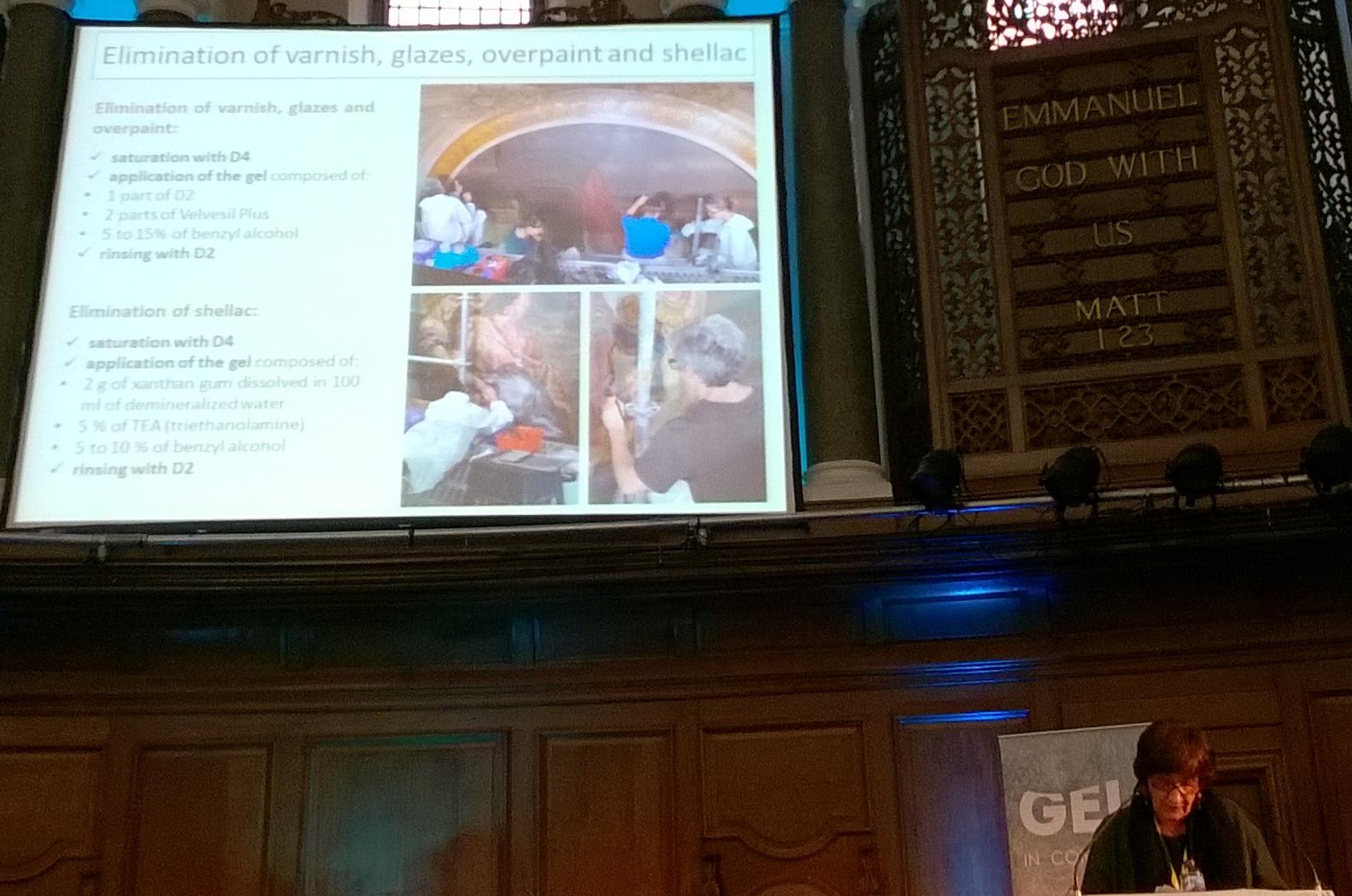
In the second of four talks, Alina Moskalik-Detalle presented “Conservation of murals by Eugene Delacroix at Saint Sulpice, Paris.” The talk was interesting for its scale and challenges. Because I’ve gone to see these murals many times over the years, the talk was also personally interesting. Each time I visited, I left somewhat disappointed by the darkened, flat, dull murals. As luck would have it, I was scheduled to travel to Paris a week after attending the gels conference. What I saw when I visited Ste. Sulpice was truly remarkable—color, depth, and drama. The cleaning had totally transformed these murals. Naturally, I couldn’t help myself, I actively looked for shiny patches—the results from this treatment were remarkable. This multi-year project involved numerous conservators including collaboration with Richard Wolbers. Some of the treatment challenges included flaking paint, complex paint layers, multiple restorations, rising damp in the walls, carbon based grime, and, if that wasn’t enough, the paint was very sensitive to organic solvents. The conservators wanted to limit penetration of their solvent gels without leaving a residue or tide line behind. They wanted good contact between the gels and the substrate, control of the action of water, and to create mixtures of solvents that would clean effectively without damaging the paint layers. After cleaning tests were performed, a treatment protocol emerged: by pre-saturation of the areas being treated with cyclomethicone followed by the application of silicone solvents gels to the mural’s surfaces, tide lines were avoided, grime could be removed, the gels could be cleared, and residue was limited. The D4 was a slow evaporator which allowed about a 30 minute working time for the application of the gel and subsequent grime removal without harming the paint layer.
Delacroix mural detail, during treatment
The gels were made and applied in a paste-like consistency for maximum control of where the material was placed. It clung to the vertical walls and horizontal ceiling long enough to be effective. Using D4 based emulsions to clean the mural’s paint surfaces allowed the removal of surface soil without stripping wax or oily components from the paint films themselves. Because the emulsions were surfactant free, it was easier to clear them from the treated surfaces. Analysis of samples didn’t show residue left behind on the surface, but when the conservators tried to consolidate flaking areas of paint, they had trouble with adhesion, it is unclear why. It will be interesting to see how these murals age over time and if further treatment is needed in future, how re-treatable it is.

After treatment
This blog series is a result of receiving the FAIC Carolyn Horton grant to help me attend the conference. I would like to gratefully acknowledge the FAIC for helping make it possible for me to attend this important conference.
Friday, March 2, 2018
Recap Gels In Conservation Conference 3 of 6
The London Gels in Conservation Conference: An Introduction
Written by Jodie Utter, Senior Conservator of Works on Paper, Amon Carter Museum of American Art.
Lu Allington-Jones, “Giant sequoia: an extraordinary case study involving Carbopol gel”
This blog post is part three of six in a series of observations about the London “Gels in Conservation” conference co-hosted by the Tate and IAP (International Academic Projects, Ltd). In mid-October, over the course of three days, some 41 authors presented research, techniques and ideas on gels in conservation. The talks were excellent, and I’ve focused on four that were notable for the wide range of materials treated and challenges faced. They ranged from coating/grime removal from a giant sequoia tree cross section, to dirt and varnish removal from Delacroix wall paintings, to removal of repairs from a fragile felt hat from a 18th century shipwreck, and an experiment comparing residues left behind by various gels on paper.
Image of cross section in upper gallery
Gel application and removal images
This blog series is a result of receiving the FAIC Carolyn Horton grant to help me attend the conference. I would like to gratefully acknowledge the FAIC for helping make it possible for me to attend this important conference.
Thursday, March 1, 2018
Recap Gels In Conservation Conference 2 of 6
The London Gels in Conservation Conference: An Introduction
Written by Jodie Utter, Senior Conservator of Works on Paper, Amon Carter Museum of American Art.
Richard Wolbers and Paolo Cremonesi
This blog post is the 2nd in a collection of observations about the London “Gels in Conservation” conference co-hosted by the Tate and IAP (International Academic Projects, Ltd). In mid-October, over the course of three days, some 41 authors presented research, techniques and ideas on gels in conservation. The first presentations of the first day kicked off the conference, setting the tone with intriguing philosophical, as well as practical hands-on examples of gels in conservation. The two leading conservation scientists in the field of gels, Richard Wolbers and Paolo Cremonesi, each provided an introduction to gels in conservation, what has been done historically, what is currently practiced, and thoughts for the future. Wolbers not only delivered the key note presentation, but spoke several times as collaborator for many of the talks and as a moderator. In his keynote address, Wolbers emphasized minimizing toxicity through substitution of less toxic materials and Cremonesi discussed the characteristics of agar gels and the current work being done with thermo-reversible rigid agar hydrogels.
Bottom line, it seems that the basic goal for many of the case studies that were presented is to find a way to safely use aqueous cleaning systems on water-sensitive materials without damaging the object. A tall order.
Wolbers said, when confronted with a treatment problem, first determine if a gel is appropriate. Gels keep the gel and its contents in contact longer with the surface; gels make local application controllable or they can serve as a poultice. Naturally, the gel used shouldn’t impact the surface medium, and it should be non-toxic and clean the object. Wolbers listed some of the advantages of solid rigid agar gels: they dissolve in water, improve surface wettability, and have surfactant properties.
Ultimately, to do the best by our objects, we as a field need to continually look to other industries for ideas. For example, the cosmetic industry utilizes green chemistry to reduce exposure to potentially harmful solvents. We need to truly understand what we want to achieve in a particular circumstance and tailor it to our object, rather than relying on a few stock recipes and applying them to all situations. As conservators we must remain agile and stay creative. To do this we must understand the underlying principles of the materials we want to use and the objects we are treating. Conservation needs to be able to gain ideas and experience from other fields, and also be able to create and engineer our own materials to give us the type of control we need.
In Cremonesi’s talk, “Thermo-reversible rigid agar hydrogels: their properties and action in cleaning”, (here is the link to Cremonesi’s talk, https://www.youtube.com/watch?time_continue=10&v=UbbxCQR4El8) he listed the advantages of agar gels: how they dissolve in water, and improve surface wettability. They have limited adhesion to the surface and, most importantly, leave behind minimal residue (as compared to gellan gum. (See M. Sullivan’s paper “Rigid polysaccharide gels for paper conservation: a residue study”). Past drawbacks of agar gels had been that they could only be applied to relatively flat surfaces. However, if the liquid gel is applied (brushed or poured on) just at the moment it starts to thicken, it can be used on a variety of surfaces, planar or not.
(here is the link to his talk: http://academicprojects.co.uk/gels-conference/gels-conference-presentations/)
Thermo-reversible gels are often prepared in the microwave to prepare a homogeneous gel. When heated above 80F (Cremonesi recommended type E for its low gelling temperature) the gel is liquid and when cooled below 80F it is a solid. With increased concentration, the gel becomes stiffer which will slow the release of water from the gel. While in the liquid form it can be poured into receptacles such as a syringe body. Allowed to cool, once solid it can be kept in a “pencil” shape (this slide caused many audience members to swoon) or be cut into small plugs.

At room temperature it can also be grated, with the shaving manipulated for surface cleaning. Enzymes mixed with Agar in a semi-solid state are the most effective form of the material. That said, Cremonesi said gellan gum is more appropriate for works on paper because it’s more flexible and transparent than agar.
One thing I’ve found with using gels (in my case gellan gum) is the formation of tide lines, which made me assume we were doing something wrong. According to both Wolbers and Cremonesi, I was missing a step. They talked about the importance of pre-wetting the surface to be treated with a non-polar solvent (they specifically mentioned D5, aka decamethylcyclopentasiloxane aka cyclomethicone). At first this might seem counter-intuitive: how does water work if there's non-polar solvent in the way? Actually it’s about displacement - oil floats on water – so the water in the gel displaces the non-polar solvent to get to the surface. The non-polar solvent prevents tidelines principally by blocking capillarity. Now it’s all starting to make sense. The same principle was used by Burgio, Rivers et al (2008, Studies in Conservation) when consolidating matte paint. On this basis, any non-polar solvent (first spot tested) should work to prevent tidelines. D5 has the advantage of being a ‘green’ solvent, comes without the H&S hazards associated with hydrocarbon non-polar solvents, and is exceptionally non-polar.
This blog series is a result of receiving the FAIC Carolyn Horton grant to help me attend the conference. I would like to gratefully acknowledge the FAIC for helping make it possible for me to attend this important conference.
Subscribe to:
Posts (Atom)